
Choosing Panel Thickness for Office Furniture and Kitchen Units
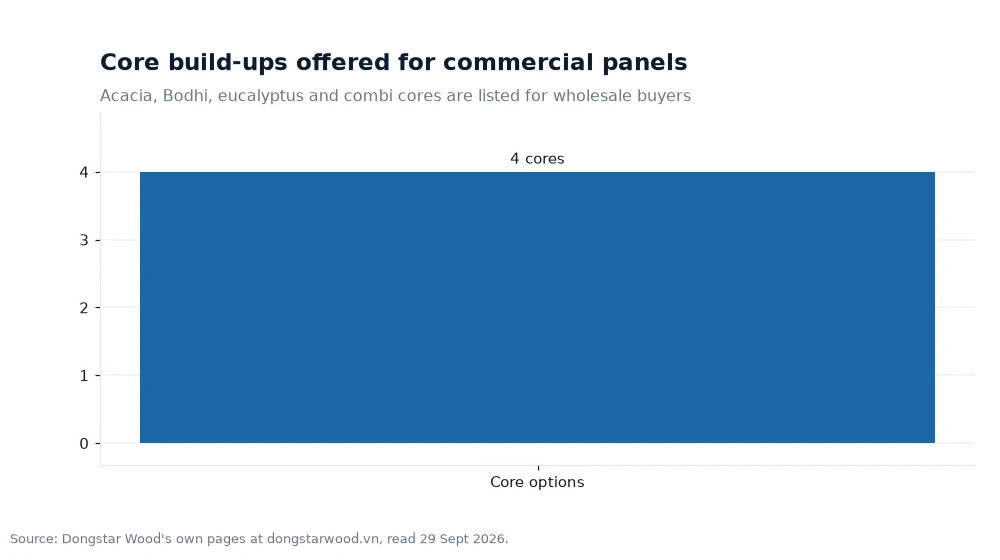
Selecting the right panel thickness for office furniture and kitchen units is a decision that sits between structural needs and material cost, and it pays to match each application to a specific gauge before placing an order. Dongstar Wood offers commercial plywood in a published thickness window from 6 mm through to 18 mm for heavy-duty use, with core choices that include Acacia, Bodhi, Eucalyptus and Combi.
Key takeaways
- Four core build-ups — Acacia, Bodhi, Eucalyptus and Combi — are listed for wholesale buyers.
- Thickness runs from 6 mm for light partitions up to 18 mm for heavy-duty worktops and structural panels.
- MR glue suits dry interiors; BWR glue handles humidity and light water exposure in kitchen environments.
- Contractors often standardise on 12 mm and 18 mm to reduce specification variety across projects.
Why thickness matters more than face veneer
The face veneer — whether Birch, Pine, Bleached Poplar, EV or Rose Eucalyptus — determines the look of the finished piece, but thickness determines how it performs under load. A cabinet back at 6 mm will flex and bow under its own weight if the span is too wide; a 12 mm partition holds its shape across a standard office bay; an 18 mm worktop resists the point loads that kitchen prep surfaces face daily. Fixing the thickness before discussing surface finish removes a layer of ambiguity from the quotation process.
The manufacturer's own guidance sorts each application into a thickness band rather than recommending one gauge for every job. At the heavy end, 18 mm covers worktops, structural panels and heavy-duty furniture. The middle band of 12–15 mm suits hotel fixtures, office furniture and shelving. Light interior work — partitions, drawer bottoms and cabinet backs — sits at 6–9 mm. Many contractors standardise on just two gauges, 12 mm and 18 mm, because that pair covers the majority of a typical programme.
Core build-ups and what they mean in practice
Strength and stability are decided at the core. Acacia is a dense, high-strength hardwood that suits applications needing superior load-bearing capacity and a long service life. Eucalyptus provides the strongest compression and bending performance of any core in the range, making it the densest hardwood option. Bodhi — also called White Hardwood — balances mechanical strength with cost-performance, a useful combination for office shelving and display fixtures where appearance and weight both matter.
Combi core blends two species — typically Eucalyptus and Acacia, or Hardwood and Softwood — to balance strength, weight and cost across a single panel. For a kitchen cabinet run where the panels are not expected to carry extreme loads, a Combi core at 12 mm offers a practical middle ground between a lightweight partition and a fully structural worktop.
Glue classes: MR versus BWR for interior environments
The adhesive that binds the veneer layers is specified by a letter code, and choosing the wrong one can be expensive. MR — Moisture Resistant — is designed for dry interior use, which covers most office furniture, shelving and partition systems. BWR — Boiling Water Resistant — is specified for environments where humidity is higher or where occasional water contact occurs, which makes it the appropriate choice for kitchen cabinetry, bathroom vanities and any unit positioned near a sink or dishwasher.
For projects where the panels will sit in a permanently humid zone the manufacturer offers additional glue grades including E0, E1, E2 and WBP, along with Phenolic Dynea systems for higher exposure levels. The point is to match the adhesive to the environment, not to default to the lowest-cost adhesive and hope the conditions are benign.
Veneer plywood options for European buyers
European buyers sourcing Commercial Plywood from Vietnam benefit from a specific duty advantage. No Anti-Dumping Tax is stated for European and US markets, which changes the landed cost calculation compared with supply from other origins. That saving is material when a buyer is comparing panel prices at the factory gate against alternatives that carry an additional tariff burden at the port of entry.
Face veneer choices for the commercial range include Birch, Pine, Bleached Poplar, EV and Rose Eucalyptus veneer plywood, and the core options — Acacia, Bodhi, Eucalyptus and Combi — give buyers a way to tune strength and cost independently of the surface finish. The published applications cover furniture plywood, cabinet construction, general building, packing and flooring, which reflects the breadth of the product range rather than a narrow specialism.
Panel area calculations for a kitchen fit-out
Once the thickness and core are fixed, the next step is to calculate how many sheets are needed for a run of cabinets. A standard kitchen unit at 600 mm deep and 720 mm tall uses panels that can be cut from a 1250 × 2500 mm sheet. The area of that sheet is 1250 × 2500 = 3,125,000 mm² = 3.125 m². A run of 20 base units, each requiring approximately 0.45 m² of panel for the carcase, consumes 20 × 0.45 = 9.0 m² of material — roughly three sheets of 1250 × 2500 mm, allowing for cutting waste and offcut recovery.
Scaling that across a full project with 40 units and 15 wall cabinets gives a total of 40 × 0.45 + 15 × 0.32 = 18.0 + 4.8 = 22.8 m² of panel, which is approximately 8 sheets of 1250 × 2500 mm. These are worked examples, not fixed specifications — actual cutting plans depend on the layout — but the arithmetic gives a buyer a realistic baseline for the order quantity before the final drawings are complete.
| Application zone | Thickness range | Typical use |
|---|---|---|
| Light interior | 6–9 mm | Cabinet backs, drawer bottoms, partitions |
| Standard fixtures | 12–15 mm | Office furniture, shelving, hotel fixtures |
| Heavy-duty | 18 mm | Worktops, structural panels, heavy furniture |
| Core options | 4 build-ups | Acacia, Bodhi, Eucalyptus, Combi |
Worked example: cost impact of switching core at 18 mm
To see how core choice affects material weight and handling, take a single sheet of 1250 × 2500 mm at 18 mm thickness. The sheet area is 1250 × 2500 = 3.125 m². A dense Eucalyptus core at 18 mm will weigh more per square metre than a Combi core at the same thickness, which affects both freight cost and on-site handling. If the Eucalyptus variant weighs 18% more than the Combi, and a Combi sheet weighs approximately 28 kg, then the Eucalyptus sheet weighs 28 × 1.18 = 33.04 kg. Across 100 sheets that is a 504 kg difference in container weight — enough to matter when a 40ft container is loaded to capacity.
Frequently asked questions
Which thickness is best for kitchen cabinets?
For kitchen cabinet carcases the manufacturer's published guidance places 12 mm as the standard choice for most units, with 18 mm reserved for worktops, heavy shelves and any panel that will bear point loads from appliances. MR glue suits dry interiors while BWR adhesive handles the humidity and occasional water contact found in kitchen environments.
Can I mix thicknesses in a single order?
Yes. Commercial plywood is available in multiple gauges within the same specification, and contractors commonly order 12 mm and 18 mm together to cover both standard fixtures and heavy-duty panels in one shipment. Mixing thicknesses in a single container does not affect the duty position or the certification set, so the logistical overhead is minimal.
What core should I specify for office shelving?
Bodhi core — also known as White Hardwood — offers a balance of mechanical strength and lighter weight that suits office shelving and display fixtures where appearance and handling are both important. For shelves that will carry heavier loads such as archives or binders, Acacia core at 12 mm or 18 mm provides higher density and load-bearing capacity.
Moving from specification to order
Once thickness, core and glue class are fixed, the remaining decisions are face veneer, grade and packing. The manufacturer's six certifications — ISO, CE, SGS, FSC, EUDR and BSCI — cover the documentation that European buyers need, and the duty position removes the tariff question from the landed-cost calculation. Buyers who want to explore the broader product range beyond the commercial line can check the birch plywood range for applications that need a light-coloured face and fine grain, or review the formwork plywood pages for structural and concrete-contact panels. Each path starts with the same principle: match the specification to the application, then let the quotation follow.
Every number in this piece was drawn from Dongstar Wood's own site reviewed on 29 September 2026[1].